
 By Emery Elliot
A modern cruise ship is effectively a floating city, requiring an intricate organizational structure to operate safely and efficiently. While passengers enjoy fine dining, theatrical entertainment, and pristine ocean views, thousands of crew members work behind the scenes to maintain the vessel’s equilibrium. The seamless execution of a cruise depends on a highly disciplined hierarchy, where every individual balances their routine department duties with emergency maritime responsibilities.
Understanding the vast array of roles onboard requires examining the distinct departments that manage navigation, guest services, culinary operations, and mechanical systems. Each sector operates under strict international maritime regulations to ensure the safety of everyone onboard while delivering a premium vacation experience.
The Deck Department and Ship Command
The deck department holds ultimate responsibility for the safe navigation, stability, and physical security of the vessel. This team operates under the direct command of the ship’s Master, commonly referred to as the Captain.
The Captain
The Captain is the supreme authority onboard the vessel. Their responsibilities transcend simple navigation; they are legally accountable for the lives of all passengers and crew, the safety of the ship, compliance with international maritime laws, and environmental protection protocols. The Captain monitors weather patterns, coordinates with port authorities, and serves as the final decision-maker in all emergency situations.
Bridge Officers
Assisting the Captain on the bridge are the navigation officers, who manage the physical trajectory and continuous monitoring of the vessel.
-
Staff Captain: The second-in-command, responsible for the daily management of the deck crew, ship security, and supervising maintenance on the hull and superstructure. The Staff Captain assumes full command if the Captain becomes incapacitated.
-
Chief Officer: Manages the cargo, ballast water tracking, and the maintenance of all safety and lifesaving equipment, including lifeboats and liferafts.
-
First, Second, and Third Officers: Watchstanding officers who rotate shifts on the bridge twenty-four hours a day, monitoring radar systems, managing electronic charts, and ensuring the ship maintains its designated course safely away from maritime hazards.
The Bosun and Deckhands
While officers manage navigation from the bridge, the Bosun serves as the foreman for the physical deck crew. Under the Bosun’s direction, deckhands execute the heavy physical labor required to preserve the ship’s structure. This includes painting, rust prevention, securing mooring lines during docking maneuvers, and operating the heavy machinery associated with the anchor systems.
The Engineering Department and Technical Infrastructure
Hidden beneath the passenger decks is the engineering department, which maintains the mechanical heart of the floating city. This team ensures continuous propulsion, electricity generation, waste management, and climate control.
The Chief Engineer
The Chief Engineer leads the technical department and holds a rank equivalent to the Staff Captain. They are responsible for the operation and maintenance of the main diesel-electric engines, propulsion pods, fuel storage systems, and mechanical safety mechanisms. The Chief Engineer manages fuel efficiency and monitors compliance with strict international maritime pollution regulations.
Technical Officers and Specialized Engineers
Operating under the Chief Engineer is a highly technical hierarchy of specialized mechanics and electricians.
-
First Engine Officer: Supervises the daily mechanical operations inside the engine room, assigning tasks to junior engineers regarding motor overhauls and pump maintenance.
-
Hotel Engineer: A specialized role focused entirely on passenger comfort, managing the ship’s massive heating, ventilation, air conditioning systems, plumbing lines, and galley cooking equipment.
-
Chief Electrician: Oversees the electrical grid of the entire vessel, managing high-voltage generators, interior lighting systems, and electronic communication lines.
The Hotel Operations and Guest Services Department
The hotel department is the largest sector onboard a cruise ship, frequently accounting for over eighty percent of the total crew population. This division replicates the infrastructure of a luxury mega-resort, managed by the Hotel Director.
Guest Services and Relations
The front desk or Guest Services Manager leads the team that acts as the primary point of contact for passengers. Guest Services Officers handle cabin account billing, address passenger complaints, process keycard replacements, and coordinate with the onboard medical team or security when guests require specialized assistance.
Housekeeping and Environmental Cleanliness
The Chief Housekeeper manages an extensive team of stateroom stewards and public area cleaners. Stateroom stewards are responsible for cleaning passenger cabins twice daily, replenishing linens, and monitoring room structural fixtures for damage. Public area cleaners work continuously through the night to sanitize high-traffic zones, theaters, casinos, and elevator banks, which is critical for preventing the spread of contagious gastrointestinal illnesses like norovirus.
Culinary Operations and Food and Beverage Management
Providing thousands of meals daily across multiple fine dining rooms, buffets, and specialty restaurants requires exceptional logistics and culinary discipline, managed by the Food and Beverage Director.
The Executive Chef and Kitchen Brigade
The Executive Chef oversees the entire culinary operation, managing inventory budgets, menu compliance, and food safety standards. Under their command is a strict kitchen brigade, including Sous Chefs who run individual galleys, Pastry Chefs, and line cooks specialized in specific cooking stations. The culinary team must adhere to rigid United States Public Health standards, ensuring precise temperature controls and flawless sanitation across all food preparation surfaces.
Restaurant and Bar Service Teams
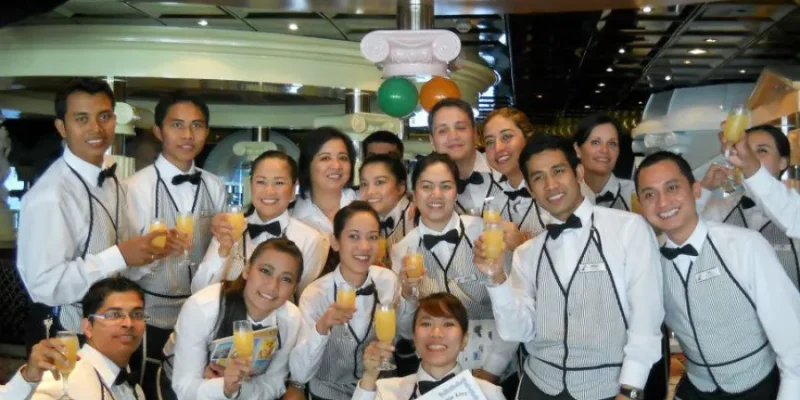
The front-of-house dining experience is managed by the Maitre D, who coordinates table assignments and supervises the restaurant staff.
-
Dining Room Waiters: Deliver personalized table service, managing pacing and accommodating complex passenger dietary restrictions.
-
Assistant Waiters: Support the primary waiters by clearing plates, pouring water, and transporting heavy tray loads from the galley to the dining floor.
-
Bar Managers and Bartenders: Oversee the inventory and preparation of beverages across dozens of onboard lounges, pool bars, and nightclubs.
The Entertainment and Activity Sector
The Cruise Director is the public face of the ship, responsible for generating a vibrant atmosphere and managing the diverse array of onboard entertainment options.
Production Staff and Performers
The entertainment division includes professional stage managers, audio engineers, lighting designers, and pyrotechnics experts who run the complex technical systems inside the main theater. They support the cast of dancers, vocalists, comedians, and acrobats who perform large-scale production shows nightly.
Activity Coordinators and Youth Staff
Activity hosts organize daytime passenger events, including trivia tournaments, pool games, fitness classes, and sports court challenges. Simultaneously, Youth Staff members run specialized children’s clubs, providing age-appropriate activities, games, and supervision for toddlers, children, and teenagers, allowing parents to explore the ship independently.
Mandatory Emergency and Maritime Safety Responsibilities
Beyond their daily hospitality or technical roles, every single crew member onboard holds a mandatory maritime safety assignment documented on the ship’s official Muster List. This safety identity takes absolute precedence over normal job descriptions during an emergency.
Every crew member undergoes rigorous safety training mandated by the Standards of Training, Certification, and Watchkeeping for Seafarers international convention. During emergency drills or actual incidents, a stateroom steward may transform into a lifeboat commander, a bartender may become a muster station guide responsible for counting passengers, and a deck engineer may join the primary fire brigade wearing full breathing apparatus. Regular weekly drills ensure that the crew can mobilize instantly to handle fires, hull breaches, medical crises, or evacuation scenarios with perfect precision.
Frequently Asked Questions
How long do cruise ship crew members typically work before receiving a vacation?
Cruise ship crew members do not follow standard shore-based employment schedules. They sign continuous, fixed-term contracts that typically last between four and nine months, depending on their rank and department. During the entirety of the contract, crew members work seven days a week without standard weekends or full days off, though they receive dedicated break periods during the day when their specific shift duties end. Once a contract is completed, they receive several weeks or months of unpaid vacation at home before signing a new contract.
Where do the crew members sleep and live while onboard the vessel?
Crew members live in dedicated crew quarters located on the lowest decks of the ship, usually beneath the passenger cabins or below the waterline. Lower-ranking crew members typically share a compact cabin with a fellow coworker from their department, featuring bunk beds, storage lockers, and a shared bathroom. Higher-ranking officers and managers receive private cabins with expanded square footage. The crew area also features its own private amenities, including a crew mess hall, a dedicated bar, a gym, a recreation room, and laundry facilities completely separate from passenger spaces.
What is the specific role of the ship Security Officer regarding passenger conduct?
The Chief Security Officer, often a former law enforcement or military professional, manages a team of security guards responsible for maintaining order onboard. They control access points at the gangway using electronic scanning systems to prevent unauthorized individuals or contraband from entering the ship. Additionally, security personnel respond to internal disruptions, investigate alleged crimes committed onboard, enforce the passenger code of conduct, and possess the authority to confine unruly individuals to their cabins or offload them to local police at the next port of call.
How does the onboard tipping system distribute funds among the diverse crew departments?
When passengers pay automatic daily gratuities or service charges, the cruise line divides these funds among the various guest-facing and behind-the-scenes service staff. This pool primarily supplements the income of stateroom stewards, main dining room waiters, assistant waiters, and culinary galley staff who prepare the food. Staff members in non-service positions, such as deck officers, mechanical engineers, and entertainment production technicians, are paid directly via standard salary structures rather than tip distributions.
What happens if a crew member becomes seriously ill or injured while the ship is at sea?
Every major cruise ship features a fully equipped medical center staffed by certified doctors and nurses. Crew members have access to complimentary medical care within this facility for minor illnesses and occupational injuries. If a crew member suffers a critical, life-threatening medical emergency while the ship is far from land, the medical team will stabilize the individual in the ship’s intensive care unit while the Captain coordinates an emergency medical evacuation via helicopter or redirects the vessel toward the nearest port with an advanced trauma hospital.
Do cruise ship crew members have to pay taxes on the income they earn onboard?
Tax obligations for cruise ship crew members depend fundamentally on their nationality and the tax laws of their home country. Many cruise lines are registered in international open registries like the Bahamas or Panama, meaning they do not automatically deduct income taxes from crew paychecks. Citizens of nations with residence-based taxation systems must track and report their foreign earned income independently when they return home, while citizens from countries with strict worldwide taxation rules must comply with localized international tax brackets.


